Self-Service Portal
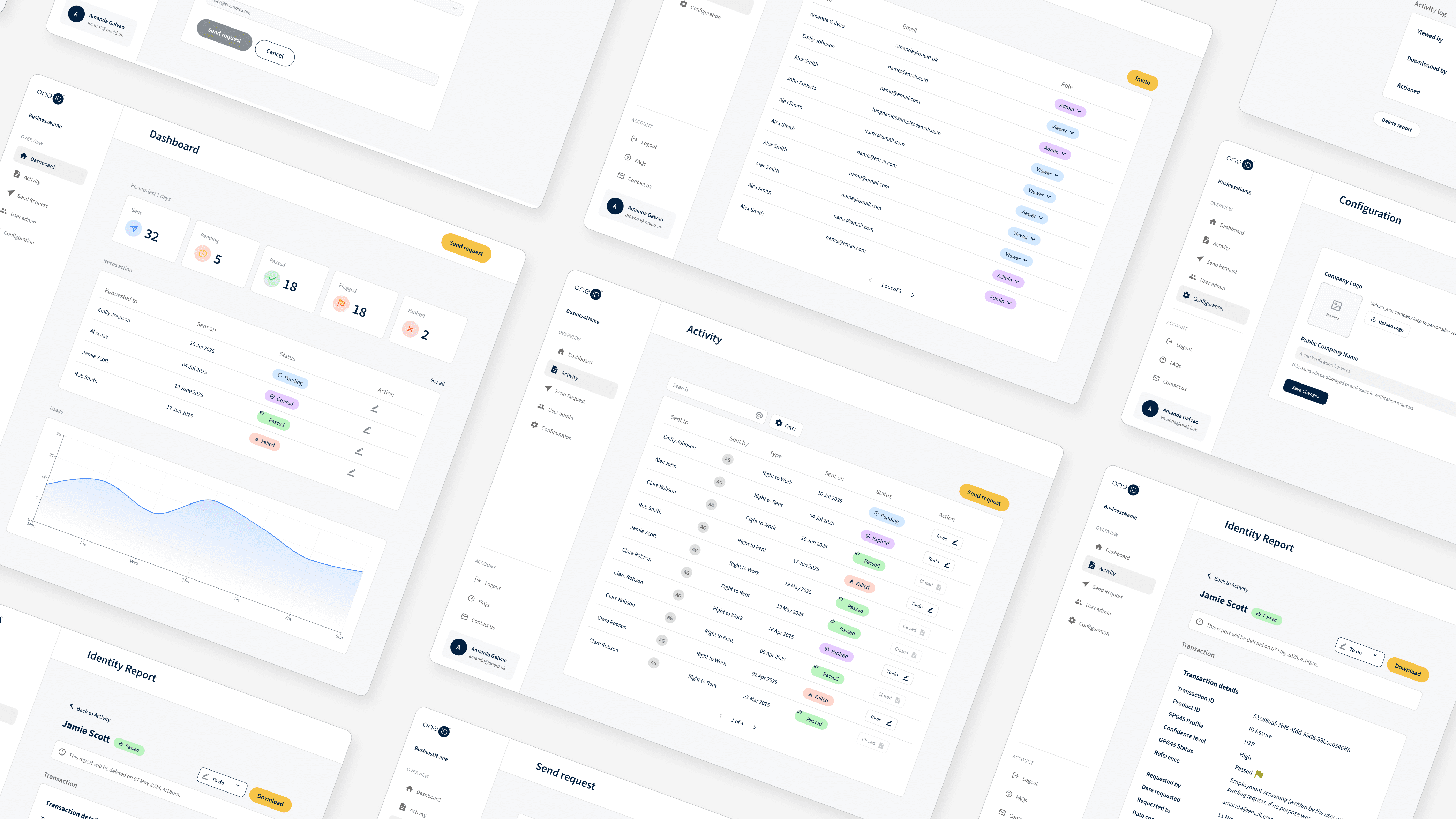
OneID Self-Service portal is a standalone portal designed to simplify how businesses manage their customers' identity verification completed through OneID.
The goal of this project was to create a self-service interface that allows customers to configure and manage verification flows without requiring them to deploy engineering support, reducing onboarding friction and enabling scalable product adoption for smaller businesses.
Company
OneID®
Role
UX/UI Designer
Timeline
Jun-Jul 2025
The Problem
Businesses integrating OneID need developer support to configure verification flows and access results. This creates a few challenges:
Onboarding depend on customers' engineering availability, often rare for smaller businesses.
Non-technical customers struggled to understand integration requirements.
Support requests for OneID were increasing as adoption grew.
These limitations slowed down product adoption and created operational overhead.
Framing the Approach
To help smaller businesses adopt our solution without overwhelming our internal team with ticket load, I designed a self-service portal where businesses could send verification requests, manage results and receive an understandable, PDF-exportable result for audit trail.
Process
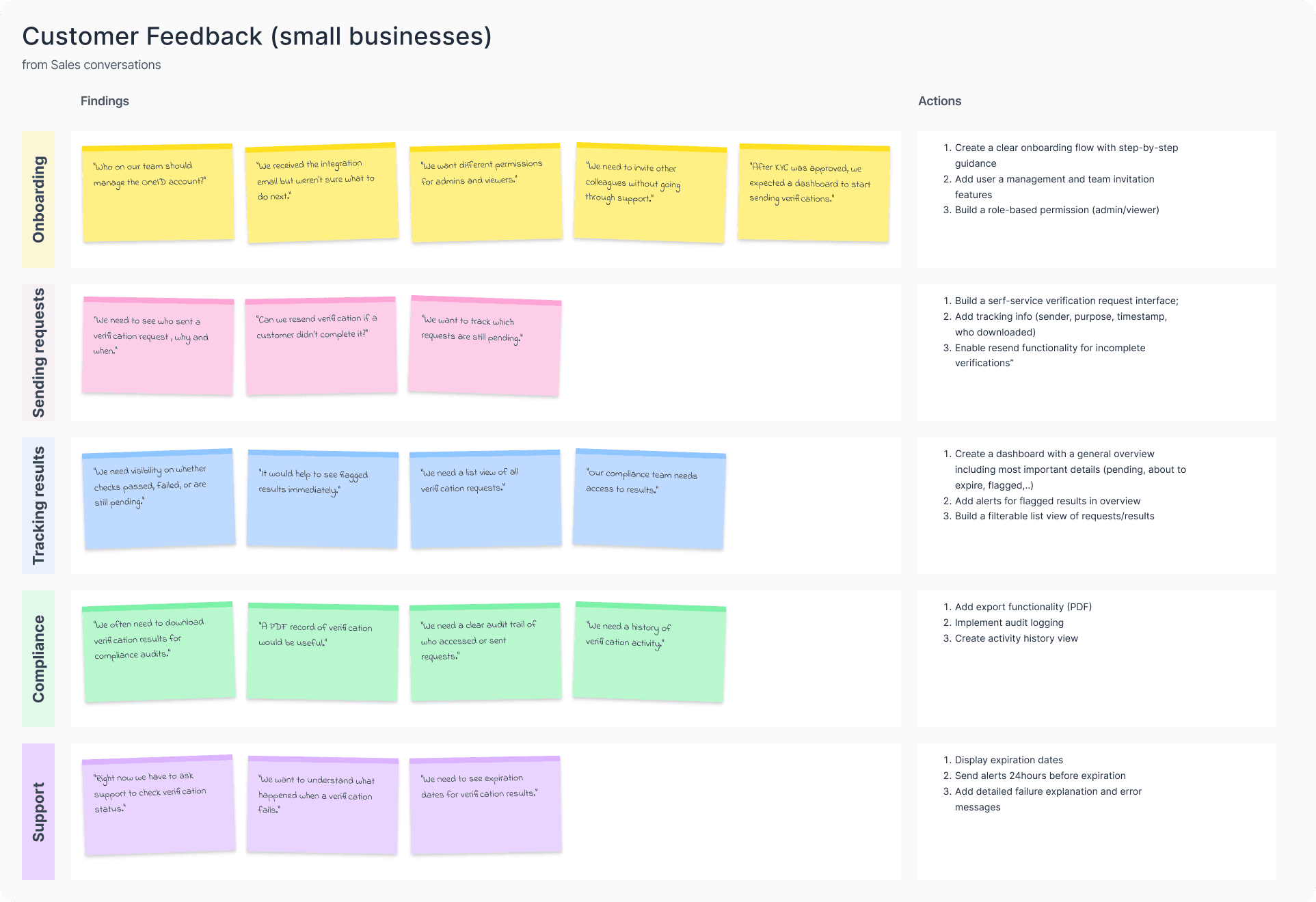
To define the product direction, I worked through a structured discovery and design process. Key activities included:
1
Analyse support requests and internal workflows
2
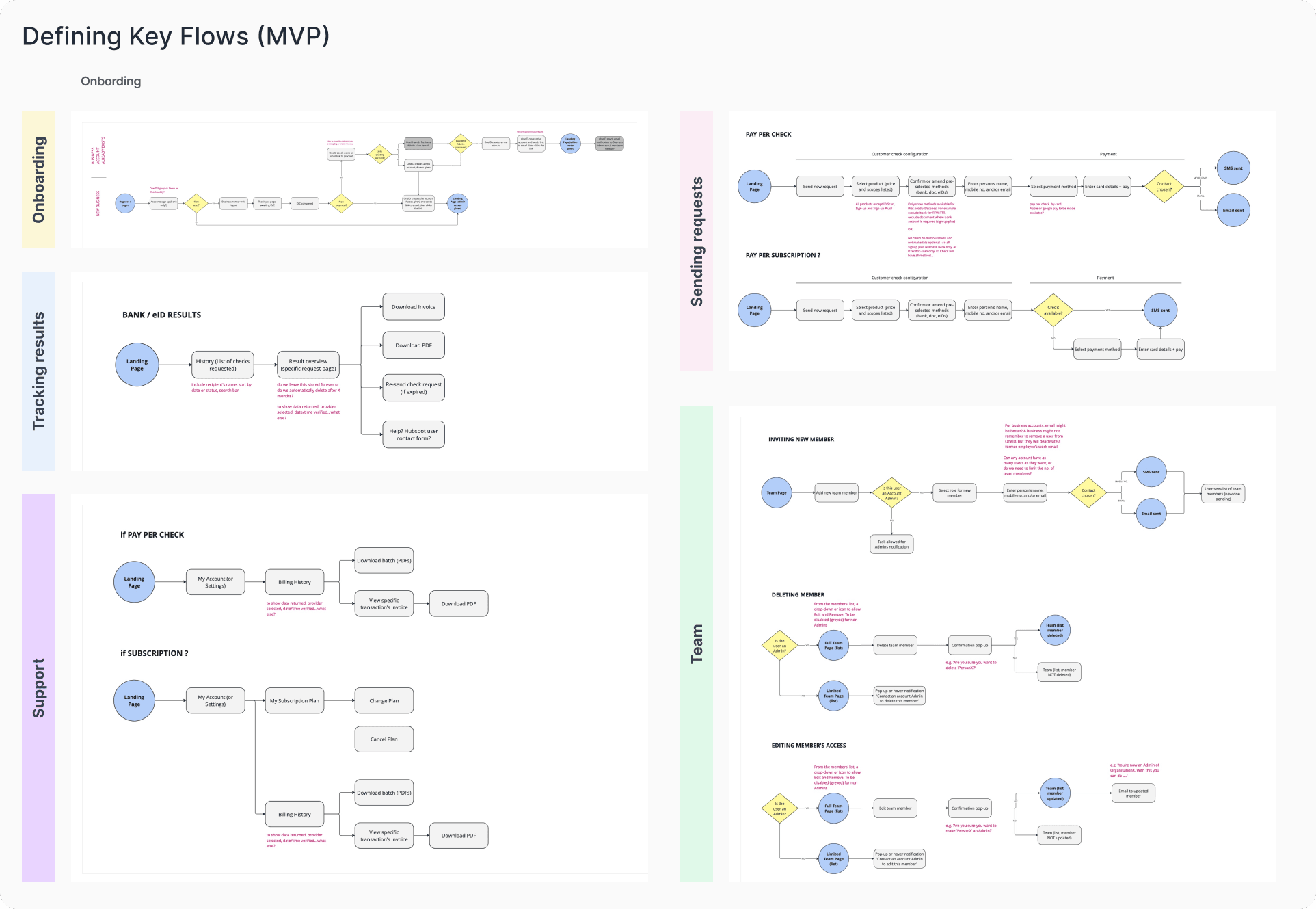
Define MVP features and its flows
3
Explore interface patterns
Research
Define
Configuration
Since MVP would be a proof of concept, we decided not to enable a configurable verification process but to start with Right to Work and Right to Rent solutions, both require the same verification method (document scanning). Those were also the use cases that most requested a no-code solution.
Scalable structure
The structure and interfaces needed to allow for multiple provider types in the future, as we knew some potential customers were interested in document scanning, bank checks and credit reference agencies silent checks.
Security
Since OneID is a Government-certified identity provider with several no-document, low-friction ID checks available, it made quickly verify new portal users' identity. After all, this portal would display extensive sensitive end-user data.
Design
Validate
Excel exports
While PDFs were considered useful, it was mentioned Excel files are easier fed into other platforms they may use.
Activity status
Every activity was marked as 'To-Do' vs 'Closed'. That was confusing for both customers, proving we needed to think further how this could behave making easy for teams to understand results that haven't been actioned yet.
Email notifications
One customer suggested email notifications sent to the user who requested the verification so they don't risk delaying any required actioned.
AI Refinement
Adopt
Dashboard scannable layout Overview>Action>Details
Activity filtering within the list frame, so it doesn't conflict with future new sections
Action is clearer displayed as text instead icon
Insert logo (configuration) format
Avoid
Dashboard was turned in a metric-first analytic tool, initial design was task-driven
Action update directly from the Activity list view can lead to user error
Identity Report was heavily simplified, skipping essential requirements
PoC Launch
Impact
KPIs & Expected Impact
Reduced tickets
Customers should be able to manage verification flows independently.
Faster onboarding
Increased adoption
Operational scalability
The portal should allow the product team to support more customers without increasing manual support.
Reflection
To validate the portal concept, I built a full proof-of-concept prototype using Figma Make and shared it with internal teams.
The prototype allowed stakeholders to explore key areas of the experience, including user management, verification management, and the dashboard overview. This helped align engineering, product, and commercial teams around how a self-service portal could work in practice.
Shortly after this phase, a shift in company strategy led OneID to prioritise larger enterprise customers and API integrations. As a result, work on the small-business self-service portal was paused. While the concept remains part of the longer-term roadmap, it was deprioritised in favour of initiatives focused on scalability and enterprise adoption.
Even though the portal has not yet been launched, the prototype helped clarify the operational requirements for self-serve verification, align internal teams around a potential future product direction, and create a foundation that could be revisited if the small-business segment becomes a strategic priority again.
Get in touch
a.galvao@outlook.com
linkedin.com/in/amanda-galv/
© 2026 London